Insights · For contractors
Aerial footage for completed cladding remediation projects
A finished remediation job is mostly invisible from the pavement. Aerial film and stills show the whole envelope at once, which is what a bid panel, a client and a LinkedIn audience need to see. The work is in planning the shot list around an occupied building.
By Sam Hendrick · published 8 October 2026 · 8 min read
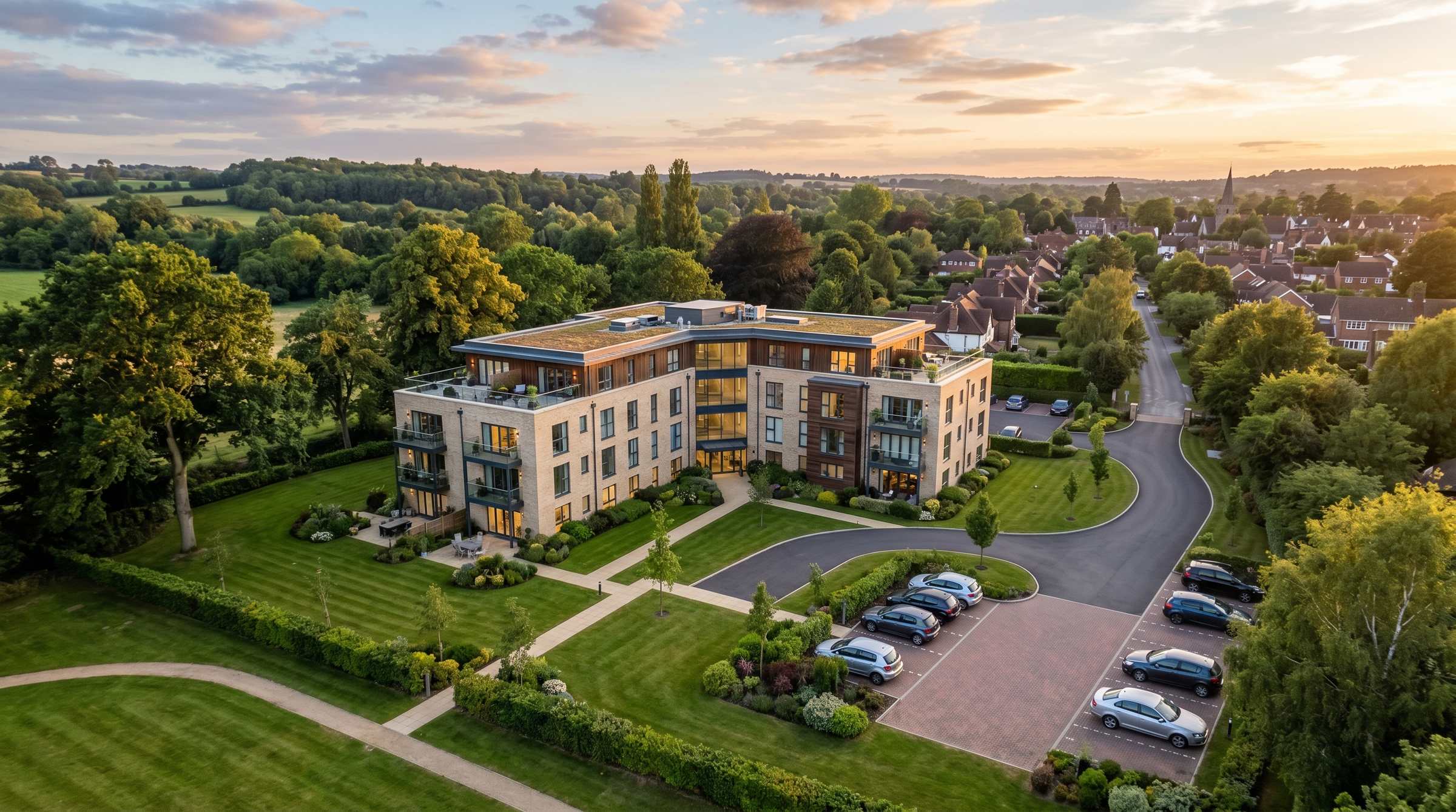
Aerial footage of a completed cladding remediation project shows the whole building envelope in one view, which is something ground-level photography cannot do on a block above four or five storeys. A good shoot combines slow, close passes along each elevation, a wide reveal of the building in its setting, and a set of high-resolution stills for bids and case studies. On an occupied residential block, the planning around residents, privacy and airspace matters as much as the flying.
This article is for remediation contractors’ marketing and bid teams, and for operations directors who want a usable record of finished work. It covers what to shoot, how to plan it around residents, and what to ask an operator for before the day.
Why film a finished remediation job from the air?
Most remediation work is hard to photograph well from the ground. The new rainscreen, the cavity barriers and the replacement insulation are behind or above the line of sight of anyone standing on the pavement. A ground-level photo of an 11-storey block shows the bottom three floors in detail and the rest in steep perspective.
A drone solves that. It can hold a level camera at any floor, track along an elevation at a steady distance, and pull back to show the building complete. For a contractor, that turns a finished job into evidence you can use in three places:
- Bids and tenders. A panel assessing remediation contractors wants to see comparable completed buildings. Clean, level stills of each elevation are more persuasive than a single hero shot.
- Case studies and the website. A short edited film of a completed block, with before stills if you have them, tells the story of the job in under a minute.
- LinkedIn and client reporting. Housing associations, managing agents and building owners often want to share the finished result with residents and their own boards. Giving them footage strengthens the relationship.
The volume of this work is not slowing down. The government’s monthly building safety remediation data, published by the Ministry of Housing, Communities and Local Government, shows thousands of 11-metre-plus buildings still moving through the various funding schemes, with more being added to the pipeline each month. Contractors competing for that work need a portfolio that shows finished buildings clearly.
What shots should a cladding remediation shoot include?
A useful shoot is built around the elevations, not around the drone. Plan the shot list before anyone books a date.
Close facade passes
These are the core of the shoot. The drone tracks slowly along each elevation at a consistent distance and height, so the new cladding reads as a continuous surface. Passes are usually flown at two or three heights to cover the full building, and on corners where two elevations meet, because corners and junctions are where the quality of the detailing shows.
How close the drone can fly to the facade depends on the operator’s authorisation, the risk assessment for that site and whether anyone could be on a balcony or at an open window. The operator sets the distance per site. Do not promise a client a specific distance until the operator has assessed it.
Reveal orbits
A slow orbit around the building, starting tight and pulling out to show it in its street or estate context, is the shot most people remember. It works best as the opening or closing shot of an edit. Fly it in low sun if possible: late afternoon light rakes across the new panels and shows texture and colour that flat midday light hides.
Elevation stills
Level, square-on stills of each elevation, taken from a height that minimises distortion, are the most practical deliverable for a bid team. Ask for them at full resolution with consistent framing across every building you have done, so a bid document can show a run of comparable projects side by side.
Roof and junction detail
If your scope included roof edges, parapets, window surrounds or balcony replacements, ask for top-down and oblique stills of those details. They are often the parts of the work a client asks about, and the hardest to see from anywhere else.
Context and approach
A short approach shot from the street, and a wide view showing the block in its neighbourhood, help a viewer understand the scale of the building and the access constraints the team worked around.
How do you film an occupied residential block?
Most remediation projects are occupied buildings, and residents have lived with scaffolding, noise and disruption for months or years. A drone outside their windows on the day the scaffold comes down needs handling with care.
Tell residents in advance
Ask the client or managing agent to send a short notice to residents a week or so before the shoot: the date, the time window, what the drone is for and who to contact. Most complaints about drone filming come from people who did not know it was happening. A notice on the entrance door on the day helps too.
Privacy and data protection
Filming a residential building for commercial use falls under UK data protection law if identifiable people are captured. The Information Commissioner’s Office has long advised that organisations using drones should consider whether filming is justified and keep the recording of individuals to a minimum. In practice that means:
- planning flight lines that look at the cladding, not into flats,
- avoiding lingering shots on windows and balconies,
- choosing a time of day when fewer residents are on balconies,
- reviewing the edit and stills before release, and blurring or removing any frame where a person or the inside of a home is identifiable.
This is general guidance rather than legal advice. If the client has its own data protection requirements, follow them.
Uninvolved people and separation distances
Under the CAA’s standard permission for flying in built-up areas (the PDRA01 Operational Authorisation), operators must keep at least 50 metres from uninvolved people, reduced to 30 metres during take-off and landing, and may only fly over them to a minimum extent. A resident on a balcony, a passer-by on the footpath and a neighbour in their garden are all uninvolved people. Some operators hold authorisations with different conditions, based on their own safety case.
That has a direct effect on the shot list. Close facade passes may need to be flown when balconies are clear, from a take-off point inside a controlled area, or with ground crew managing access to the footpath below. The operator should explain in the RAMS how they will manage this on your building. Our walkthrough of a drone RAMS for a construction site covers what that document should contain.
Permission to take off and land
The operator needs permission from whoever controls the land they take off from. On a residential estate, that is usually the building owner or managing agent, not the contractor once the site has been handed back. Sort this out before the day, in writing.
Does airspace affect where you can film?
Yes. A large share of London’s remediation work sits inside airport Flight Restriction Zones, particularly around Heathrow in the west and London City Airport in the east, or in central London restricted airspace. Flying inside a Flight Restriction Zone needs permission, applied for in advance, and lead times can run to several weeks.
The rules depend on the exact location and they change, so the operator should check the airspace for each address and tell you in writing what permission is needed and how long it takes. If a quote for a site inside a Flight Restriction Zone has no allowance for permissions, ask how the operator plans to get them. Our guide to drone filming costs in London explains how permissions affect a quote.
Can you film several completed blocks in one day?
Often, yes, and it is usually the best value. Remediation contractors tend to have several finished buildings in the same borough or across neighbouring boroughs. Filming them in one planned day means the operator mobilises once, and the footage is shot in the same light with the same kit, so the buildings look consistent when they sit side by side in a bid document.
What limits the number of sites in a day is the travel time between them, the airspace at each one, and how long each building takes to cover properly. A mid-rise block with four elevations, a reveal orbit and a full set of stills is typically a few hours on site including set-up. Three or four buildings in one day is realistic if they are close together and none needs a long wait for permissions. Sites in different Flight Restriction Zones may each need their own application.
For portfolios of buildings, our multi-site media service is built around delivering every site to the same standard with per-site pricing.
What should you ask for in the brief?
Send the operator a short brief before asking for a quote. It saves a round of questions and gets you a more accurate price.
- Addresses of every building, with postcodes.
- What the footage is for: bids, website, LinkedIn, client handover, awards entries. This decides whether you need an edit, raw footage, stills or all three.
- Scope highlights: which elevations, details and junctions matter most.
- Before material: any stills of the building before works started. A before-and-after pair is the strongest single asset a remediation contractor can have.
- Occupancy and access: who manages the building, who to contact for permission to take off, and any resident sensitivities.
- Dates: preferred dates and any deadlines, such as a bid submission. Allow time for airspace permissions.
- Usage rights: confirm you can use the footage in bids, on your website and on social media without further fees, and whether the client also wants a copy.
What deliverables should you expect?
A typical delivery for a completed remediation project includes:
- a short edited film per building, often 45 to 90 seconds, with a cut-down for social,
- a set of full-resolution elevation stills, consistently framed,
- detail stills of roofs, parapets and junctions,
- optionally, the raw footage for your own future use.
Ask for stills in a format your bid team can drop straight into a template, and for files named by building and elevation so they are easy to find in two years’ time.
Frequently asked questions
Can a drone film close to an occupied tower block?
Yes, with planning. The operator flies under a CAA authorisation that sets separation distances from uninvolved people, so close passes are timed and positioned to avoid residents on balconies and people below. The exact distance is set per site in the risk assessment.
Do residents need to give permission for drone filming?
Individual residents do not normally give permission, but the building owner or managing agent should approve the shoot and residents should be told in advance. Footage should avoid capturing identifiable people or the inside of homes.
Is drone footage useful for bids if it was not filmed during the works?
Yes. Completion footage shows the quality of the finished building, which is what most bid panels want to see. It is not a record of the works in progress, so do not present it as one.
How long does a shoot take per building?
For a mid-rise block, a few hours on site including set-up is typical, depending on the number of elevations, the shot list and the weather. Airspace permissions can add weeks of lead time before the shoot itself.
Can we combine several finished buildings in one day?
Usually. Grouping sites by location keeps travel short and gives consistent footage across the portfolio. Sites in different restricted airspace zones may each need separate permission.
There are more answers on airspace, insurance and procurement on our FAQs page.
If you have finished remediation projects you want on film, send us the addresses and what the footage is for. We will check the airspace for each building and come back with a plan and a written quote.
Get in touch or call 0207 458 4997.