Insights · For developers
Briefing a video crew when your site is at groundwork stage (and there is nothing yet to film)
The most common objection from developer marketing teams is that there is nothing to film yet. The site is muddy. The frame has not gone up. The renders are the only visual asset. None of that is a reason to wait.
By Sam Hendrick · published 14 May 2026 · 8 min read
The objection sits inside almost every first conversation with a developer marketing team. The site is at groundwork. There is nothing visually impressive to film yet. Should we wait until the frame is up.
The honest answer is no. The first episode is the most important one. Waiting until the building is visible misses the structural value of the format and starts the buyer relationship two quarters late. This is the article on how to brief a crew when the site is muddy and the architecture is invisible.
Why the first episode is the one to lead with
The compounding value of a quarterly programme depends on starting at groundwork. The eight episodes that cut into a single time-lapse on completion only work if Episode 1 captures the site before the building is there. Wait two quarters and the time-lapse begins at slab level. Wait four quarters and you have a film of a half-built tower with no record of how it got there.
The sales argument also runs the wrong way. Buyers commit money during the off-plan period. The off-plan period is at its tensest exactly when the site looks the least convincing. Quarter one is when the buyer’s confidence is at its most fragile. The film is doing its highest-trust work in the quarter that feels like it has the least to show.
The third reason is operational. The crew learns the site over the first two episodes. The site team learns to be on camera. The flight path gets locked. The CGI overlay pipeline gets calibrated. By Episode 3 the production is humming. Skip the early episodes and you start that learning curve when the building is mid-rise and the consequences of getting a shot wrong are higher.
What you film when there is nothing to film
The brief at groundwork sits on three pillars. Each one is doing the work that finished architecture would otherwise do.
Pillar one. CGI overlay composited into live aerial.
This is the headline trick. The architectural render of the finished building is composited into the live drone footage of the actual site. The overlay holds at the same orientation, the same frame, the same lighting condition. The buyer sees, in one shot, the muddy plot as it is and the finished building as it will be.
The technical requirement is straightforward in principle and exacting in practice. The drone flies a fixed flight path and captures the site to known coordinates. The architectural render is composited in post, oriented to the same flight path, lit to match the time of day of the live shot. The render’s vanishing point lines up with the live footage’s perspective. The render fades in and out cleanly so the buyer perceives the composite, not a clumsy graphic overlay.
This is the cut that justifies the whole format at groundwork stage. There is genuinely nothing to film. There is also nothing to render alone. The two together do the job neither does on its own.
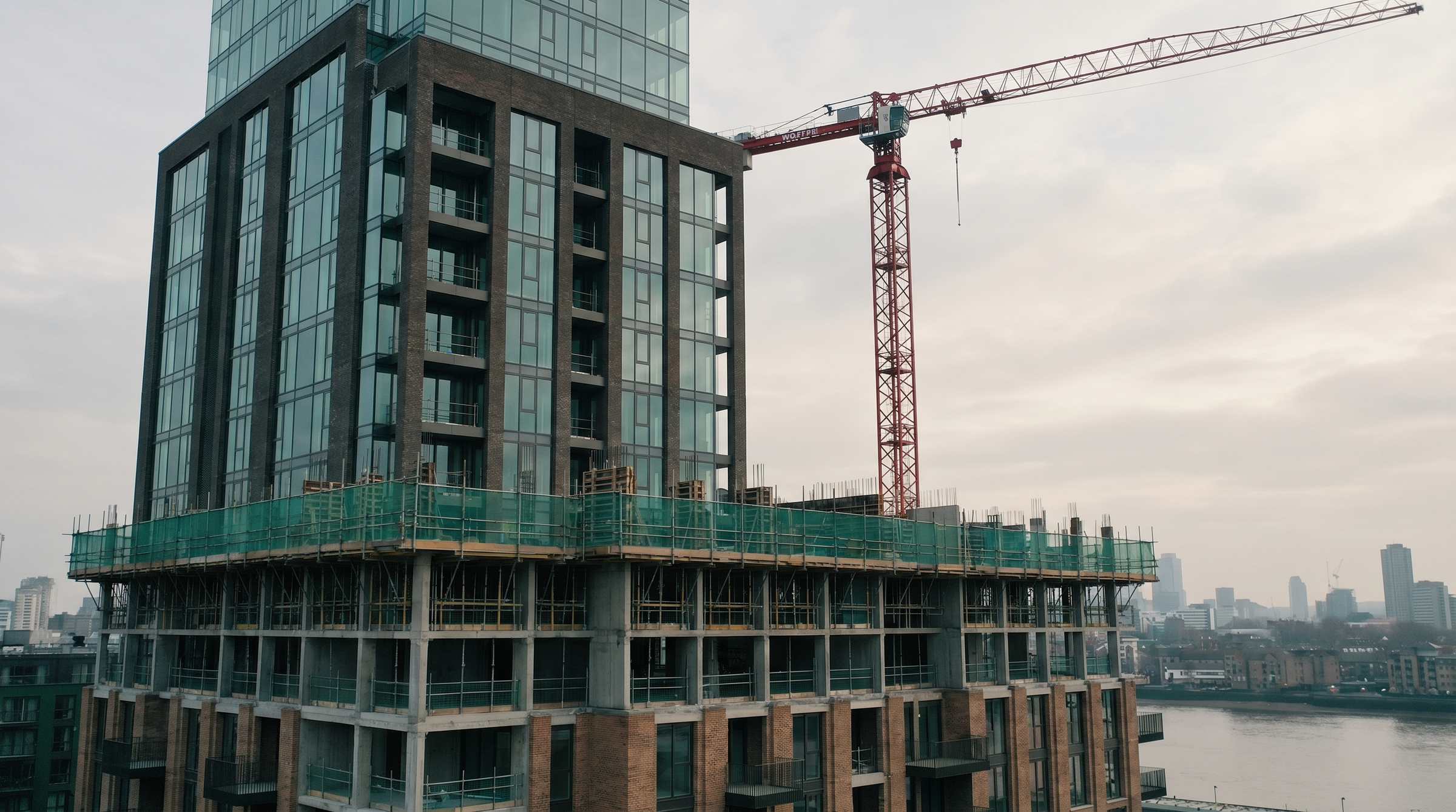
The Ballymore programme at The Capston started at groundwork stage. Episode 1 was filmed before the first slab went down. The CGI overlay carried the entire visual argument. The buyer saw the muddy plot, the foundations going in, and the finished tower composited into the same aerial. The overlay was the centrepiece of every cut. Two years on, the same flight path will produce the time-lapse that records the whole build.
Pillar two. On-camera interviews with site management and engineering.
The second pillar at groundwork is people. There is no architecture to look at. There are people on site, doing work that matters. The film puts them on camera.
Site managers, project directors, foundations engineers, surveyors, structural engineers. Two on-camera voices per episode is the right number. They explain what was completed in the quarter, what is happening this week, and why it matters at this stage of the build. The buyer hears it from the people responsible for it. No voiceover. No corporate narrator.
The framing matters. Hi-vis, tight head-and-shoulders, the live site in soft focus behind. The frame says “this is real, I work here, the building is being made by people”. At groundwork stage when the visual evidence is thin, the human voice is what carries the trust function entirely.
Brief the developer’s customer liaison or project director on the on-camera shortlist before the shoot. Confirm who is available, who is comfortable on camera, and who has the operational authority to make a forward statement. The site manager handles the past quarter. The project director handles the next quarter. That is the structural division. It should hold across the eight episodes.
Pillar three. Archival framing.
The third pillar is the framing of the episode as a record, not a marketing asset. The voice of the film, the title cards, the lower-thirds, the closing card all signal that the buyer is watching documentation. The episode is the developer’s quarterly correspondence to the buyer base. It is not a launch trailer.
Archival framing matters at groundwork because the buyer’s reasonable question is “why am I watching a film of a hole in the ground”. The answer the framing gives is “this is the first episode of the record of your building going up”. The buyer accepts that. They accept it because the film is presented as the first of an eight-episode programme, not as a piece of marketing communication that has to justify itself on its own.
The closing end card on Episode 1 reads “the next update will land in three months”. That single line establishes the cadence. The buyer settles into the rhythm. They are not asking why the film is so short on visible progress. They are noting when the next one is coming.
What to brief the crew before the first shoot
A short list of the things to lock down with the producer before Episode 1 is filmed.
The flight path. The drone path that will be flown every quarter. Locked to specific GPS coordinates. The same approach, the same elevation, the same circuit. This becomes the time-lapse on completion. Get it right at Episode 1 because changing it later breaks the continuity of the archive.
The on-camera shortlist. Three to six named people across the site team who will appear on camera across the programme. Confirm with each of them that they are willing to be filmed and that they have the authority to make on-record statements. Check their schedule against the proposed shoot windows for the eight episodes.
The CGI source files. The architectural renders, the elevation drawings, the floor plans, the master scheme model. The production team needs the assets that will be composited. Tier one developers usually have these to hand. Tier two and three developers sometimes need to commission a renderable asset specifically. Sort this before the first shoot, not after.
The pre-launch buyer reference. The information that the buyer base already has. The brochure, the units list, the original launch communications. The film should not contradict the existing materials. The on-camera people should be briefed on what the buyer base has been told already.
The cadence calendar. The eight shoot dates, marked two years out. Buyers expect quarterly. The dates need to land within a fortnight of the same time each quarter. Putting them in everyone’s calendar at the start of the programme is the difference between a programme that runs cleanly and one that drifts.
The site access logistics. The crew need a defined point of entry, a brief on the live site rules, the RAMS submitted ahead of the visit, and a named site contact for the day. Mobilisation is the same as any contractor. Sort it before the first shoot.
What changes from Episode 1 to Episode 8
The structure stays. Four beats, two on-camera voices, the CGI overlay, the archival framing, the closing card. The content shifts as the build emerges.
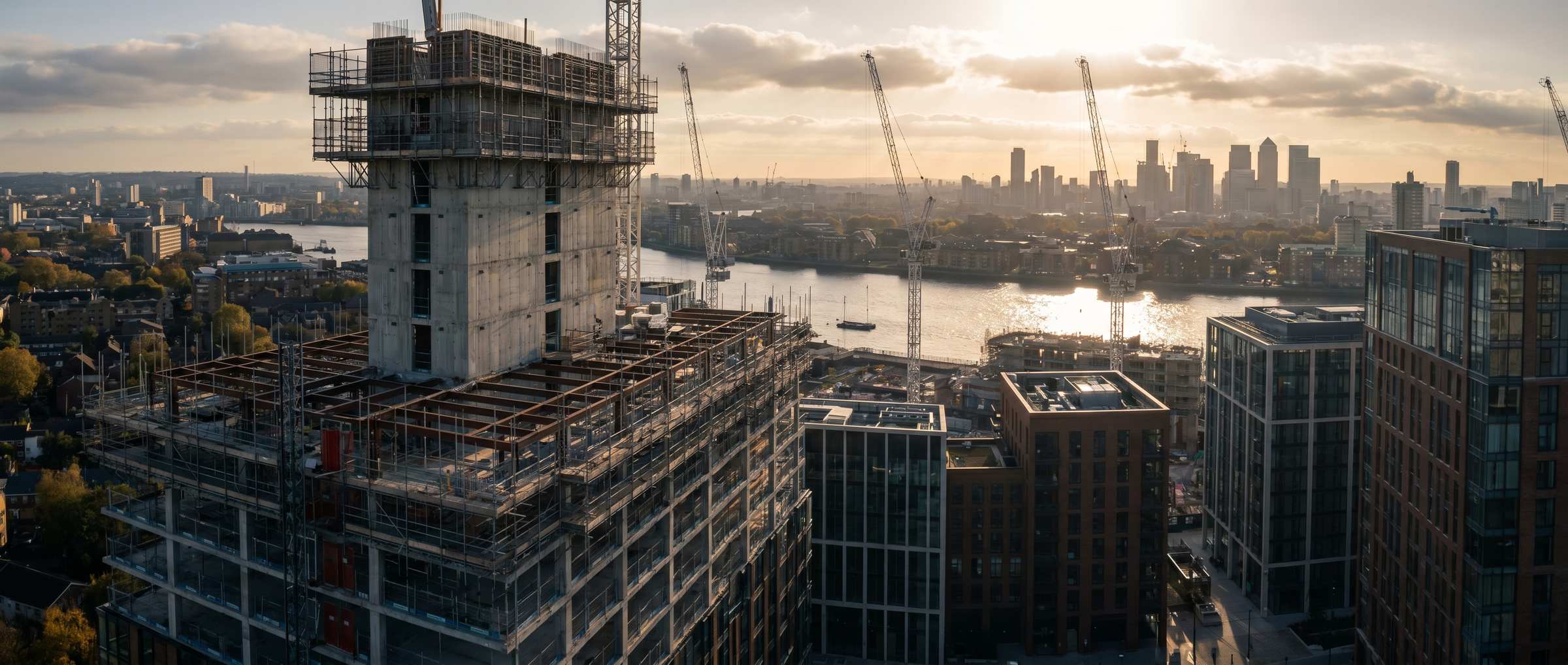
By Episode 4 the structural frame is up. The CGI overlay shifts. The render fades into a building that is now visibly there. The buyer sees the brochure image and the actual frame at the same vanishing point, each becoming the other. The composite is more powerful at structural stage than at groundwork because the live evidence has caught up to the render.
By Episode 6 the facade is going on. The CGI overlay starts to recede. The live building is doing more of the work. The on-camera voices shift toward the fit-out and the handover programme.
By Episode 8 the building is largely complete. The CGI overlay is gone. The live shots carry the film. The closing episode is the handover record. The eight cut into a single sequence becomes the time-lapse.
This trajectory is why the brief at Episode 1 needs to be right. The structure has to support all eight episodes. The flight path has to capture the building at every stage. The on-camera shortlist has to remain available through to handover. The CGI assets have to be built once and refreshed quarterly.
What we would recommend, briefly
If you are commissioning a quarterly programme on a development that is currently at groundwork or about to break ground, a short list.
- Start at Episode 1, not Episode 3. The first two episodes are the foundation of the time-lapse archive.
- Lead the visual argument with the CGI overlay composited into live aerial. It carries the film at groundwork stage when nothing else can.
- Lock the on-camera voices early. Two voices per episode, the same two people across the programme where possible.
- Lock the flight path on the first shoot. Treat it as a permanent infrastructure decision, not a creative one.
- Frame the film as the first episode of an eight-episode record. The buyer accepts the thin visual progress at quarter one if the framing is right.
- Brief the producer once at the start of the programme. Not eight times, every quarter. The retained model only works if the brief is set once.
Ballymore did all six of those things on The Capston. The case study sits at /work/ballymore-the-capston. The first episode was shot before the first slab went down. The film carried the buyer base through the gap.
If you are about to break ground on a development and the marketing brief has not been written, a 20-minute call covers the brief, the flight path, and the cadence. We send a written proposal within five working days.
Book a 20-minute call or call 0207 458 4997.